


 PLATFORM UPDATE:


Fe-assisted nitridation-induced reconstruction of Mo–Fe–Ni molybdates enables durable alkaline seawater oxygen evolution and Zn–air batteries

Abstract
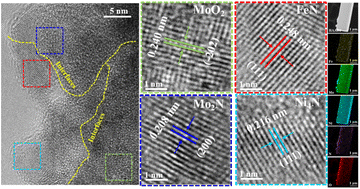
Controlling phase evolution during nitridation is essential for creating active interfaces in multi-metal electrocatalysts. However, the nitridation pathways in complex systems such as Mo–Fe–Ni molybdates remain poorly defined. Herein, tuning the Fe contents in the Fe–Mo precursor directly governs ammonia activation and drives nitridation-induced reconstruction. Increasing Fe concentration promotes NH3 decomposition, shifting the product from an NH3-treated oxide-dominant phase with partial nitrogen incorporation (MoO2, FeMoO4, NiMoO4, and NiO, denoted as N/MoO2–MoFeNi–O) to a nitride-dominated heterostructure comprising MoO2, Mo2N, FeN and Ni4N (N/MoO2–MoFeNi–N). The optimized N/MoO2–MoFeNi–N nitride–oxide interfaces enhance conductivity, regulate adsorption, and strengthen corrosion resistance. As a result, N/MoO2–MoFeNi–N exhibits superior oxygen evolution performance in both alkaline freshwater and seawater, requiring overpotentials of only 309/392 and 334/499 mV to reach 500 and 1000 mA cm−2, respectively. DFT calculations identify the MoO2@FeN interface as the most active site with the lowest energetic barrier for the potential-limiting step. The catalyst also demonstrates efficient oxygen reduction activity, enabling high-performance zinc–air batteries with an open-circuit voltage of 1.33 V, a peak power density of 84.2 mW cm−2, and stable cycling over 140 h. This work clarifies the role of Fe in directing nitridation pathways, providing a rational route to construct durable, interface-rich nitride–oxide architectures for advanced oxygen catalysis.
- This article is part of the themed collection: Advanced Nanomaterials for Sustainable Green Hydrogen Production
 Please wait while we load your content...


