


 PLATFORM UPDATE:


Negative-to-positive electrode soluble species crossover induced accelerated degradation in lithium-ion batteries
 *abcd
*abcd
Abstract
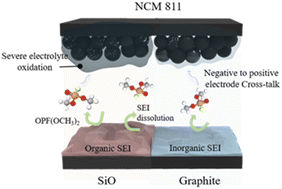
Si-based negative electrodes are promising alternatives to graphite because of their exceptional theoretical capacity and potential for fast-charging Li-ion batteries (LIBs). However, the large volume changes in Si and the instability of the solid electrolyte interphase (SEI) result in severe capacity fading and performance degradation. In this study, the degradation mechanisms of SiO-based negative electrodes were investigated, with a focus on negative-to-positive electrode crosstalk that accelerates full-cell failure. The SEI on SiO is predominantly organic and exhibits high thermal solubility, which leads to the dissolution of the SEI components into the electrolyte. The resulting alkyl fluorophosphate species (OPF(OCH3)2) undergo oxidative decomposition on Ni-rich NCM811 positive electrodes, inducing interfacial resistance growth, particle cracking, and electrolyte depletion. High-temperature storage tests of the SiO/NCM811 cells confirmed more severe polarization and surface damage compared with their graphite-based counterparts. Our findings indicate that stabilizing the SEI and suppressing electrolyte degradation are critical strategies for mitigating crosstalk-induced failure, enabling the development of durable high-energy LIB technologies beyond graphite negative electrodes.
- This article is part of the themed collection: Journal of Materials Chemistry A Emerging Investigators 2026
 Please wait while we load your content...


