


 PLATFORM UPDATE:


Preparation of waterborne polyurethane/silsesquioxane/carbon nanotube aerogel with rigid-flexible framework for mechanically tough and wide pressure-range properties for high-performance piezoresistive sensing
 ab
and
Hongzhi
Liu
*ab
ab
and
Hongzhi
Liu
*ab
Abstract
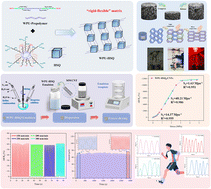
The piezoresistive response of flexible piezoresistive sensors is usually limited to narrow low-pressure regions, with limited linear stability during wide pressure variations, which presents a significant difficulty. To overcome this constraint, waterborne polyurethane (WPU) and hydroxylated silsesquioxane (HSQ) are covalently bonded to form a ‘rigid-flexible’ hybrid framework. The typical problems of low mechanical strength, poor filler dispersion, and weak interfacial bonding in traditional aerogel sensors are all concurrently resolved by this molecular-level design. The resulting WPU–HSQ8/CNT composite aerogel, created using an eco-friendly freeze-drying procedure, achieves a remarkable combination of mechanical toughness and electrical sensitivity by integrating multi-walled carbon nanotubes (MWCNTs) to form a continuous conductive network. The WPU–HSQ8/CNTs exhibit excellent dynamic stability under high compression rates, superior fatigue resistance over extended cycling, and stable multi-level piezoresistive response across an ultra-wide pressure range of 0–5 MPa, a capability rarely achieved in prior studies. The practical viability of this aerogel is proven by real-time tracking of human joint movements. This material offers a viable platform for next-generation flexible sensors in wearable health monitoring, electronic skin, and human–machine interfaces by presenting a material design strategy that resolves the long-standing trade-off between operational range and sensing stability.
- This article is part of the themed collection: Celebrating the 80th birthday of Professor Dr Ulrich Schubert
 Please wait while we load your content...


