


 PLATFORM UPDATE:


Interface-engineered silicon nano-quill electrodes for durable extreme temperature lithium-ion batteries

Abstract
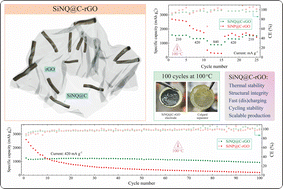
Developing thermally stable lithium-ion batteries (LIBs) is essential to enable hybrid and electric vehicles with simplified thermal management and reduced pack weight. Silicon (Si)-based electrodes are widely explored for current LIBs. However, limited attention is given to thermally resilient Si-based electrodes with industry-relevant electrode formulation. Herein, in-house-developed Si nano-quills (SiNQs) were transformed into interface-mediated SiNQ@C-rGO, featuring a nitrogen-doped carbon coating and rGO wrapping, and used to prepare electrodes from aqueous slurries. The electrochemical performance was evaluated using a piperidinium-based ionic liquid electrolyte at 100 °C. The SiNQ@C-rGO electrode delivered 1000 mA h g−1 at 840 mA g−1 and retained 73% of its capacity after 100 cycles at 420 mA g−1. Conversely, an identical commercial Si nanoparticles (SiNPs)-based electrode displayed poor rate capability and rapid degradation at 100 °C. Additionally, the SiNQ@C-rGO electrode exhibited stable cycling between 50 °C and 100 °C. Post-mortem analyses verified the superior structural stability of the SiNQ@C-rGO electrode, indicating its potential for use in thermally resilient batteries.
 Please wait while we load your content...


