


 PLATFORM UPDATE:


Photoelectrode engineering for organic synthesis: a paradigm for high-value chemical transformations
 ab
and
Li-Zhu
Wu
*ab
ab
and
Li-Zhu
Wu
*ab
Abstract
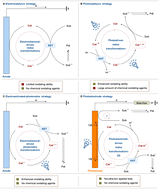
The convergence of photoelectrochemistry and organic synthesis represents a transformative platform for sustainable chemical manufacturing. This Perspective advances a fundamental paradigm shift: from merely applying known semiconductors in reactions to rational designing of photoelectrode materials as the major impetus. This burgeoning field can be divided into four core material engineering strategies: bandgap engineering, interfacial chemical engineering, defect and facet engineering, and stability/electrolyte engineering. From heterojunction photoanodes enabling bias-free cascades to defect-engineered surfaces dictating unprecedented selectivity, a unified framework linking atomic-scale material properties to macroscopic catalytic outcomes of oxidation, C–X (X = H, Cl, Br) functionalization, and cross-coupling has been established. This photofunctional materials-centric blueprint not only rationalizes existing breakthroughs but also charts a decisive course for future discovery, aiming to fully harness solar energy for the precise, efficient, and sustainable synthesis of high-value chemicals.
- This article is part of the themed collections: New Developments in Photofunctional Materials and Transformations, Journal of Materials Chemistry A Recent Review Articles and Journal of Materials Chemistry A HOT Papers
 Please wait while we load your content...


