


 PLATFORM UPDATE:


Impact of dispersed crystalline domains on lithium-ion conductivity in amorphous Li2.99Ba0.005OCl electrolytes

Abstract
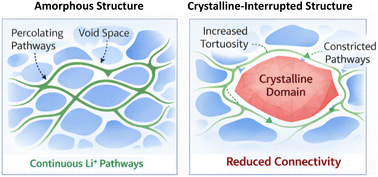
Solid-state electrolytes promise safer, high-energy batteries, yet ionic transport is limited by structural heterogeneity and interfacial resistance. We combine hydrothermal synthesis and molecular dynamics (MD) to determine how dispersed crystallinity and interfacial orientation govern lithium-ion conduction in barium-doped anti-perovskite Li2.99Ba0.005OCl. Structural and thermal analyses identify a largely amorphous matrix with embedded nanocrystallites, and MD captures the same short-range order and dispersion seen experimentally. Electrochemical impedance spectroscopy separates high amorphous-phase conductivity from a pellet-scale response dominated by interfacial limitations, consistent with direct-current polarization. Cyclic voltammetry indicates a broad electrochemical stability window. We quantify transport in crystalline domains, amorphous regions, crystalline–amorphous interfaces with (100) and (111) orientations, and composites with low and moderate levels of dispersed crystallinity. Mean squared displacement and Nernst–Einstein analyses show that conductivity is highest in the amorphous phase, lower at interfaces by several fold, and lowest in crystalline regions. Interfacial orientation strongly modulates transport, with the densely packed (111) plane suppressing mobility relative to the more open (100) plane. Alpha-shape free-volume mapping reveals greater free volume in the amorphous phase, intermediate values at interfaces, and minimal free volume in crystalline regions, which explains pathway percolation versus blockage. Increasing dispersed crystallinity reduces composite conductivity through free-volume depletion and increased tortuosity. These findings establish design rules for anti-perovskite solid-state electrolytes, mainly to maximize amorphous continuity, minimize dispersed crystallinity, and preferentially expose low-density interfacial orientations to achieve high lithium-ion conductivity.
 Please wait while we load your content...


