


 PLATFORM UPDATE:


Combined experimental and theoretical elucidation of PCET pathways in electrocatalytic alcohol oxidation and its application in PET upcycling

Abstract
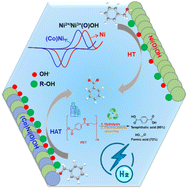
Selective electrochemical oxidation of alcohol functionalities in lignin- and polyester-derived waste provides a sustainable strategy for plastic valorization coupled with hydrogen production. Here, we present a mechanistic investigation of alcohol oxidation over a Co-doped Ni-based catalyst (aCo BDC/NF), benchmarked against undoped activated Ni foam (aNF). The aCo BDC/NF catalyst exhibits markedly enhanced activity and faradaic efficiency for both aliphatic and benzylic alcohol oxidation, arising from improved intrinsic kinetics and stronger substrate binding. Kinetic isotope effect studies identify C–H bond cleavage as the rate-determining step. Hammett analysis reveals divergent pathways: aCo BDC/NF proceeds via a neutral hydrogen atom transfer mechanism (ρ = −0.13), whereas aNF follows a hydride transfer pathway (ρ = −0.64). Eyring analysis confirms lower activation enthalpy and a more ordered transition state for the bimetallic catalyst. Electrochemical measurements and density functional theory calculations further demonstrate accelerated charge transfer and enhanced interfacial adsorption in aCo BDC/NF. Finally, efficient PET upcycling is achieved, delivering 81% formate selectivity, 92.6% faradaic efficiency, ∼97% hydrogen evolution, and 95% terephthalic acid yield, highlighting a viable route for integrated plastic recycling and hydrogen co-production.
- This article is part of the themed collection: Journal of Materials Chemistry A Emerging Investigators 2026
 Please wait while we load your content...


