


 PLATFORM UPDATE:


Improved electrocatalytic oxidation of artificial seawater with an applied magnetic field in a forward osmosis system

Abstract
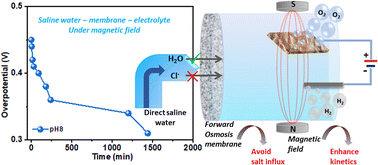
It is desirable to be able to use seawater directly for electrocatalytic splitting and hydrogen production. However, challenges such as electrode corrosion and chlorine gas evolution limit its practical application. In this study, a transition metal-based phosphide/phosphate (Ni–NiPO) catalyst on Ni foam was developed to improve charge transfer and suppress parasitic reactions. To improve stability and selectivity, a chloride ion-selective forward osmosis (FO) membrane was integrated into the system, which effectively minimised chlorine oxidation and corrosion. The FO membrane exhibited excellent stability (48 hours) and OER selectivity at pH 8. In addition, the application of a 100 mT magnetic field improved the OER kinetics, reducing the overpotential from 0.45 V to 0.31 V. It is shown that the combination of the Ni–NiPO catalyst, FO membrane and an applied magnetic field significantly improves the control of the OER.
 Please wait while we load your content...


