


 PLATFORM UPDATE:

Creating percolating Li diffusion pathways via Ge substitution enables the fabrication of thick-electrode oxide all-solid-state batteries

Abstract
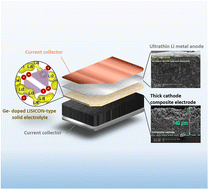
Even though oxide solid electrolytes (SEs) have several advantages such as high chemical/thermal stability over conventional liquid electrolytes, their low ionic conductivity and difficult integration during cell fabrication hinder practical application. Here, the Li ionic conductivity of the LISICON (lithium super ionic conductor)-type SE is enhanced by substitution of Ge, achieving conductivity approximately 5 times higher than that of the unsubstituted. The Ge substitution can not only increase the concentration of Li but also enhance partial occupancies of Li at specific sites, enabling additional Li diffusion pathways and thereby leading to high ionic conductivity. Surprisingly, unlike other Ge-based solid electrolytes, the Ge-substituted LISICON-type SE exhibits excellent wetting behavior with Li metal and co-sintering capability with high-capacity cathodes even at temperatures above 700 °C. The increased Li ionic conductivity and excellent co-sintering capability enable the fabrication of an all-solid-state battery (ASSB) with an ultra-thick composite electrode (∼140 µm), which delivers high electrochemical activity/reversibility at room temperature without external pressure. These findings clearly demonstrate that the LISICON-type SE with enhanced Li ionic conductivity provides a completely novel strategy for achieving high energy density in ASSBs and offers a promising route toward practical application of oxide-based SEs in high-energy density ASSBs.
 Please wait while we load your content...


