The role of oxygen excess on fluoride intercalation in Ruddlesden–Popper electrodes for fluoride ion batteries: the case of LaSrMnO4

Abstract

Ruddlesden–Popper-type compounds are particularly attractive electrode materials for fluoride-ion batteries. Among them, LaSrMnO4 has received significant attention due to its high fluoride incorporation capability and lower environmental impact compared to nickel- and cobalt-based analogues. In this work, neutron diffraction data are used to provide an experimental visualization of fluoride-ion diffusion in this class of materials, through maximum entropy method (MEM) and bond valence site energy (BVSE) analysis. Additionally, since oxygen excess is well known in Ruddlesden–Popper oxides but its impact on fluoride-ion transport has not been previously investigated, molecular dynamics (MD) simulations were employed to reveal how oxygen over-stoichiometry affects fluoride intercalation mechanisms and energetics, unveiling new migration pathways that hinder fluoride mobility. These findings have direct implications for fluoride-ion battery performance, highlighting the critical role of oxygen content in determining anion transport and the electrochemical performance of this class of materials.
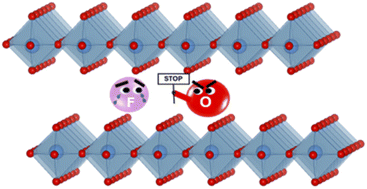
Graphical abstract: The role of oxygen excess on fluoride intercalation in Ruddlesden–Popper electrodes for fluoride ion batteries: the case of LaSrMnO4

Supplementary files

Article information

Article type
Paper
Submitted
16 Jan 2026
Accepted
01 Mar 2026
First published
12 Mar 2026
This article is Open Access
Creative Commons BY-NC license

J. Mater. Chem. A, 2026, Advance Article

The role of oxygen excess on fluoride intercalation in Ruddlesden–Popper electrodes for fluoride ion batteries: the case of LaSrMnO4

G. Mezzadra, X. Guo, M. Ravalli, C. Ritter, D. Ceresoli, O. Clemens and C. Tealdi, J. Mater. Chem. A, 2026, Advance Article , DOI: 10.1039/D6TA00453A

This article is licensed under a Creative Commons Attribution-NonCommercial 3.0 Unported Licence. You can use material from this article in other publications, without requesting further permission from the RSC, provided that the correct acknowledgement is given and it is not used for commercial purposes.

To request permission to reproduce material from this article in a commercial publication, please go to the Copyright Clearance Center request page.

If you are an author contributing to an RSC publication, you do not need to request permission provided correct acknowledgement is given.

If you are the author of this article, you do not need to request permission to reproduce figures and diagrams provided correct acknowledgement is given. If you want to reproduce the whole article in a third-party commercial publication (excluding your thesis/dissertation for which permission is not required) please go to the Copyright Clearance Center request page.

Read more about how to correctly acknowledge RSC content.

Social activity

Spotlight

Advertisements