


 PLATFORM UPDATE:


Multifunctional Z-scheme Bi-MOF/g-C3N4 photocatalyst for pharmaceutical degradation, hydrogen evolution, and electricity generation

Abstract
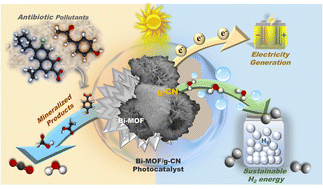
Integrating pollutant degradation with energy production offers a promising pathway for sustainable wastewater treatment. Herein, an advanced semiconductor-based photocatalytic system with dual functionality is developed by constructing a Z-scheme heterojunction composed of a bismuth-based metal–organic framework (Bi-MOF) self-assembled on conductive g-C3N4via a one-pot solvothermal method. The resulting Bi-MOF/g-CN photocatalyst exhibits enhanced light harvesting, efficient charge separation, and suppressed carrier recombination owing to the engineered hetero-interface. Under simulated solar irradiation, the optimized Bi-MOF/g-CN-15 demonstrates outstanding photocatalytic performance toward pharmaceutical pollutants, achieving 99.8% degradation of ciprofloxacin (CIP) (k = 6.52 × 10⁻³ min−1) and 91.3% degradation of acetaminophen (ACP) within 150 min (k = 2.45 × 10⁻³ min−1). The photocatalyst retains stable activity over a wide range of pollutant concentrations, solution pH values, interfering ions, and light intensities. The synergistic interaction between Bi-MOF and g-C3N4 enables effective pollutant adsorption and rapid interfacial electron transfer, while the narrowed band gap facilitates broad-spectrum light absorption and high redox capability. When employed as a photoanode in a photocatalytic fuel cell, Bi-MOF/g-CN-15 achieves 63% CIP degradation using only 2 mg of catalyst, accompanied by a short-circuit current density of 3.15 mA cm−2, an open-circuit voltage of 1.68 V, and a power density of 1.8 mW cm−2. In addition, the photocatalyst exhibits a hydrogen evolution rate of ∼2111 µmol g−1 h−1 under light irradiation. The significantly enhanced hydrogen production and pollutant degradation efficiency highlight the potential of this Z-scheme system as a cost-effective and scalable platform for integrated environmental remediation and solar energy conversion.
- This article is part of the themed collection: Advanced Nanomaterials for Sustainable Green Hydrogen Production
 Please wait while we load your content...


