


 PLATFORM UPDATE:


Phonon and charge-carrier transport decoupling via amorphous carbon coating promotes high thermoelectric cooling performance of p-type Bi0.5Sb1.5Te3
 *a
*a
Abstract
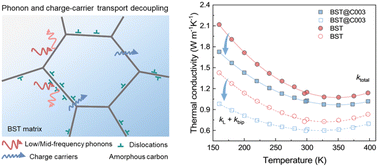
Decoupling phonon and charge-carrier transport is essential towards optimal figure-of-merits (zTs) of thermoelectrics (TEs). This remains challenging, as strategies reducing lattice thermal conductivities (kL) often bring in additional scattering centers of charge carriers, deteriorating the carrier mobility, especially at low temperatures, and limiting cooling performance at (sub-)ambient temperatures. Herein, a scalable route towards the amorphous carbon coating of p-type Bi0.5Sb1.5Te3 with an abundant precursor is developed. Combined structural–compositional investigations and extensive TE measurements demonstrate that the amorphous carbon layer, majorly composed of ordered sp2 C![[double bond, length as m-dash]](https://www.rsc.org/images/entities/char_e001.gif) C bonds and with a thickness of ca. 5 nm, results in effectively reduced kL but imposes negligible effects on charge-carrier transport in the temperature range of 160–473 K. Further transport analysis reveals that the reduction of kL originates from the selective scattering of low- and mid-frequency phonons by the carbon coating layer (as boundary defects and second-phase scattering centers) and the induced high-density dislocation defects in the vicinity of carbon–matrix interfaces. This yields over 11% increases in both average zT200–300K and zT300–400K. The constructed Peltier module delivers a maximum cooling temperature difference (ΔTmax) of 73.1 K at a hot-side temperature of 300 K. These findings show the potential of amorphous carbon coating for the independent suppression of phonon transport in TEs, especially at low temperatures, promoting the application in solid-state cooling and potentially TE power generation.
C bonds and with a thickness of ca. 5 nm, results in effectively reduced kL but imposes negligible effects on charge-carrier transport in the temperature range of 160–473 K. Further transport analysis reveals that the reduction of kL originates from the selective scattering of low- and mid-frequency phonons by the carbon coating layer (as boundary defects and second-phase scattering centers) and the induced high-density dislocation defects in the vicinity of carbon–matrix interfaces. This yields over 11% increases in both average zT200–300K and zT300–400K. The constructed Peltier module delivers a maximum cooling temperature difference (ΔTmax) of 73.1 K at a hot-side temperature of 300 K. These findings show the potential of amorphous carbon coating for the independent suppression of phonon transport in TEs, especially at low temperatures, promoting the application in solid-state cooling and potentially TE power generation.
 Please wait while we load your content...


