


Predictive phase formation in high-entropy diborides with first-principles calculations
 *abc
*abc
Abstract
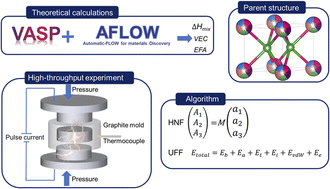
High-entropy diboride (HEB) ceramics have exhibited versatile properties. Yet, single-phase HEBs are supposedly rare; consequently, robust prediction of such HEB formation is rather challenging owing to the vast element combinations. Herein, the Automatic FLOW partial occupation methodology was employed to construct 56 quinary metal HEBs. Potential single-phase HEBs were identified through the evaluation of entropy forming ability (EFA), computed via high-throughput density functional theory calculations. EFA, derived from the energy distribution spectrum obtained through randomized calculations, effectively characterizes the accessibility of states that are equally sampled in proximity to the ground state. Furthermore, it provides a quantitative measure of configurational disorder that can contribute to the stabilization of high-entropy homogeneous phases. To achieve this, a total of 4 256 distinct configurations within the compositional space were computed. Correlating these computational findings with experimental data obtained from samples synthesized by spark plasma sintering revealed that systems exhibiting an EFA value greater than 80 (eV per atom) demonstrate a higher propensity to form single-phase HEBs.
 Please wait while we load your content...


