


 PLATFORM UPDATE:

Synergistic structural and electronic engineering for boosted oxygen evolution reaction on nickel–iron hydroxide nanocatalysts
 ab
and
Xue Feng
Lu
*ab
ab
and
Xue Feng
Lu
*ab
Abstract
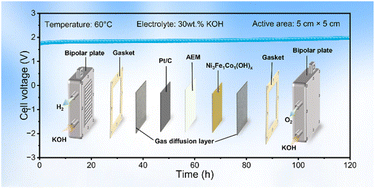
Nickel–iron layered double hydroxides (NiFe-LDHs) are highly attractive electrocatalysts toward the oxygen evolution reaction (OER), yet their practical deployment is hindered by poor electrical conductivity and restricted mass transport, leading to sluggish surface reconstruction and inadequate active site exposure. Herein, we develop a facile hydrolysis strategy to construct hierarchical nanosheet-assembled hollow spheres, effectively maximizing accessible active sites. Crucially, operando electrochemical impedance spectroscopy and Raman spectroscopy reveal that strategic cobalt substitution significantly promotes electron transfer and OH− adsorption, enabling efficient electrochemical reconstruction into the active oxyhydroxides. Benefiting from synergistic structural and electronic optimization, the resulting Ni3Fe1Co1(OH)x catalyst achieves a low overpotential of 218 mV at 10 mA cm−2. When deployed in a 25 cm2 anion-exchange membrane water electrolyzer, it delivers a current density of 1 A cm−2 at just 1.79 V with exceptional 120-hour stability at 60 °C. This work establishes a dual-engineering design paradigm for high-performance Ni-based OER electrocatalysts toward practical hydrogen production.
 Please wait while we load your content...


