


 PLATFORM UPDATE:


Influence of Al doping ratio on properties of ZnO:Al passivating contacts for crystalline silicon solar cells

Abstract
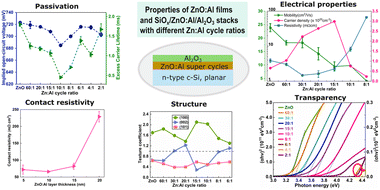
ZnO-based electron-selective passivating contacts, with a structure analogous to conventional polysilicon passivating contacts, but offering better optical transparency, have recently emerged as a promising technology for silicon solar cell applications. However, there remain significant disagreements over the optimum ZnO doping level as well as limited information on the connection between film properties and passivating contact performance. In this study, we comprehensively investigate the influence of Al doping ratio in atomic-layer-deposited ZnO:Al films within a SiOx/ZnO:Al/Al2O3 stack, where the Zn:Al cycle ratio was adjusted between 60:1 to 2:1 using a supercycle approach. The effect of Zn:Al cycle ratio on passivation and contact performance is correlated with the structural, electrical and optical characteristics of the resulting films. For thicker films, we observe a reduction of passivation with increasing Al doping, which can be alleviated by increasing the number of initial ZnO cycles before Al doping is introduced. In contrast, doping improves passivation of thinner films and also increases the effectiveness of hydrogenation by thicker Al2O3 capping layers. X-ray diffraction spectra reveal a transition in the preferred crystallographic orientation from (002) to (100) upon the incorporation of Al2O3 capping and doping. Increasing doping also leads to a significant blueshift of optical absorption. The minimum contact resistivity is obtained at a 15:1 cycle ratio (3.64 eV band gap), coinciding with the maximum electron concentration and minimum work function. The optimised stacks combine an implied open-circuit voltage of 725 mV (300 µm wafer) with a contact resistivity of ∼70 mΩ cm2. Our results help to reconcile apparent disagreements in the findings of previous studies.
 Please wait while we load your content...


