


 PLATFORM UPDATE:


Strategies to enhance the supercapacitance performance of 2D MXenes through defect engineering, doping, hybridization, and magnetic field assistance: recent progress and challenges
 a
Sathya
Arumugam Thirumalai,
b
Surjit
Sahoo
*a
and
Brahmananda
Chakraborty
*cd
a
Sathya
Arumugam Thirumalai,
b
Surjit
Sahoo
*a
and
Brahmananda
Chakraborty
*cd
Abstract
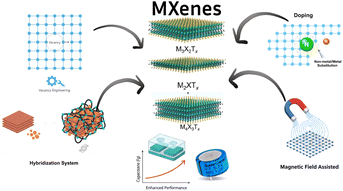
The rapid global shift towards electrification has driven a growing demand for scalable, durable, and high-efficiency energy storage systems. Two-dimensional transition-metal carbides and nitrides known as MXenes are distinct materials due to their tunable surface chemistry, exceptional conductivity, and unique layered architectures. However, challenges like limited interlayer spacings and susceptibility to restacking effects and oxidation often limit their electrochemical performance. This review critically evaluates multiple engineering strategies, such as defect engineering, doping, hybridisation, and magnetic field assistance, enhancing their specific capacitance and improving their cycling stability. Specifically, this review integrates experimental breakthroughs with density functional theory insights into ion mobility and conductivity. Furthermore, it highlights their synergy with the emerging machine learning technology, where algorithms screen over 23 000 MXene structures to identify the optimal candidates for charge storage. This work provides a roadmap for the transition from lab-scale MXene synthesis to AI-driven, high-performance supercapacitor design by bridging multiscale simulations with laboratory data. Finally, prevailing challenges such as the complexity of defect–property correlations and future perspectives to accelerate the practical realization of MXene-based high-performance supercapacitors are discussed.
- This article is part of the themed collections: Supercapacitors for a sustainable energy future and Journal of Materials Chemistry A Recent Review Articles
 Please wait while we load your content...


