


Atomically dispersed copper in TiO2 supported NiO nanoparticles drives high CH4 productivity, selectivity, and stability in CO2 methanation via reversible oxygen vacancy generation

Abstract
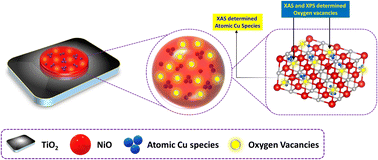
Designing efficient and durable catalysts for CO2 methanation remains a critical challenge for sustainable energy conversion. Here, we report a TiO2-supported NiO catalyst incorporating atomically dispersed copper species (1 wt%), denoted as NiO–Cu1, that delivers an exceptional CH4 productivity of 28 497 mmol g−1 h−1 at 300 °C with 92.5% CH4 selectivity, outperforming its monometallic counterpart NiO–TiO2 (12 482 mmol g−1 h−1) by 128%. More importantly, NiO–Cu1 exhibits outstanding durability, retaining 100% stability over 300 thermal cycles corresponding to 495 hours of continuous operation. X-ray photoelectron spectroscopy (XPS) analysis reveals that atomic copper dispersion generates abundant oxygen vacancies in the NiO lattice. Furthermore, in situ X-ray absorption spectroscopy (XAS) and ambient pressure X-ray photoelectron spectroscopy (APXPS) uncover that these oxygen vacancies are reversible in nature and play a key role in CO2 activation, while adjacent NiO sites facilitate H2 dissociation. This synergistic interplay between copper-induced reversible oxygen vacancies and NiO active sites enables highly productive, selective, and durable CO2-to-CH4 conversion, positioning NiO–Cu1 as a promising platform for next-generation power-to-gas technologies.
 Please wait while we load your content...


