


 PLATFORM UPDATE:


Boron-modulated amorphous cobalt layer on Cu foam enabling efficient and stable hydrolysis of ammonia borane

Abstract
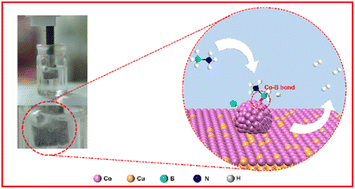
Ammonia borane (AB) is a highly promising hydrogen storage material, yet its practical application is hindered by the lack of efficient and stable catalysts for hydrogen release. Here, a boron-modulated amorphous cobalt layer on Cu foam (B-CoCu foam) is developed as an efficient and robust noble-metal-free catalyst for the AB hydrolysis. The interfacial B–Co interaction (CoxB) plays a critical role in the enhanced catalytic activity, as identified by X-ray absorption spectroscopy (XAS). In situ XAS further reveals the surface reconstruction and the increased CoxB intermediate in the presence of AB during the reaction, which significantly accelerates the hydrolysis, as confirmed by theoretical calculations. As a result, the B-CoCu foam enables rapid hydrogen production with a high turnover frequency (TOF) of 161.5 (H2) mol ((cat-metal)mol−1 min−1) and an exceptional area activity of 75.4 mL (min−1 cm−2). Notably, the B-CoCu foam retains high catalytic activity for over 40 cycles without obvious performance degradation. This catalyst can also be used in deionized water, NaOH solution or NaCl solution and drives the fuel cell to work for 60 min, demonstrating a wide range of application scenarios and excellent potential for practical applications.
 Please wait while we load your content...


