


 PLATFORM UPDATE:


Atomically dispersed Pt catalyst on ceria-carbon for suppressing C–C cleavage in glycerol electrooxidation

Abstract
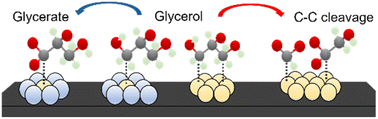
Glycerol, a low-cost and abundant byproduct of biodiesel production, has attracted attention as a feedstock for conversion into value-added chemicals. To maximize the economic value of products, maintaining three carbons (C3) as the dominant product is important yet difficult to achieve at high potentials due to the favorable C–C bond scission. We demonstrate that an atomically dispersed Pt catalyst anchored on defect-rich ceria-carbon selectively controls the glycerol electrooxidation reaction (GEOR), favoring C3 products. The isolated Pt sites favored single-carbon adsorption, preventing multi-carbon binding and subsequent cleavage up until high potential of 1.2 VRHE. The catalyst maintained nearly 70% of C3 selectivity across various potentials with high glycerate productivity and selectivity. In contrast, catalysts with Pt nanoparticles rapidly shifted towards C2 and C1 products, especially glycolate and formate as potential increases. Moreover, Pt single atoms on the catalyst maintained high glycerate productivity without much Pt agglomeration under 48 h operation. Beyond batch operation, the Pt single atom catalyst was validated in a continuous flow-cell reactor. Glycerate remained as the major product, reaching a selectivity of 51.6% as potential increases and exhibited a productivity of 37.0 mmol L−1 mgPt−1 h−1 at 1.2 VRHE. This work highlights atomic dispersion on defect-engineered supports as a powerful strategy to control electrocatalytic pathways in the GEOR via suppressing C–C cleavage.
- This article is part of the themed collection: Advances in Sustainable Catalysis: from Materials to Energy and Environmental Applications
 Please wait while we load your content...


