


 PLATFORM UPDATE:


Impact of the polymer donor side-chain length on the formation and processing of waterborne nanoparticles for organic solar cells
 †*b
Alberto Peinador
Veiga,
c
Xabier
Rodríguez-Martínez,
c
Gilles
Pécastaings,
e
Marc
Schmutz,
f
Christine
Lartigau-Dagron,
g
Antoine
Bousquet,
g
Guillaume
Wantz,
a
Jaime
Martin,
cd
Martin
Heeney
bh
and
Sylvain
Chambon
*a
†*b
Alberto Peinador
Veiga,
c
Xabier
Rodríguez-Martínez,
c
Gilles
Pécastaings,
e
Marc
Schmutz,
f
Christine
Lartigau-Dagron,
g
Antoine
Bousquet,
g
Guillaume
Wantz,
a
Jaime
Martin,
cd
Martin
Heeney
bh
and
Sylvain
Chambon
*a
Abstract
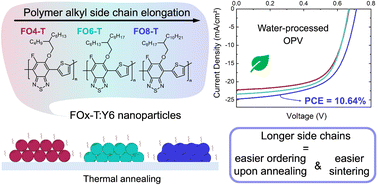
Organic photovoltaics (OPVs) have recently exceeded 20% power conversion efficiency (PCE), reinforcing their potential for commercialisation. However, large-scale adoption also depends on environmental impact, toxicity, cost, stability, and scalability. Conventional wet-processing routes typically rely on hazardous organic solvents, whereas aqueous nanoparticle (NP) dispersions offer a greener alternative and have already enabled device efficiencies above 10%. Yet strategies to tailor conjugated materials specifically for NP-based processing remain unexplored. This work examines how the alkyl side-chain length influences the performance of nanoparticle bulk heterojunctions. We investigated three conjugated polymers, FO4-T, FO6-T, and FO8-T, which were derived from a benzo[c][1,2,5]thiadiazole-based backbone and bear 2-butyl-1-octoxy, 2-hexyl-1-decoxy and 2-octyl-1-dodecoxy side chains, respectively. Donor–acceptor blend NPs were prepared via the miniemulsion method using Y6 as the non-fullerene acceptor. We correlated optical properties, NP characteristics, film microstructures, thermal annealing behaviour, and device performances to the macromolecular structure. Our findings show that the side-chain length strongly influences nanoparticle-based thin film morphology, its behaviour upon thermal treatment and the resulting photovoltaic efficiency. Among the series, FO8-T : Y6 exhibited the most favourable microstructure with a thermal treatment lower than its FO4-T and FO6-T counterparts and delivered power conversion efficiencies up to 10.64%. This study establishes structure–property relationships for water-processed organic solar cells and highlights side-chain engineering as a key lever for advancing eco-friendly, high-performance active layers.
- This article is part of the themed collection: Journal of Materials Chemistry A HOT Papers
 Please wait while we load your content...


