


 PLATFORM UPDATE:


Highly efficient electron transport layer with weak pinning and low barrier contact for solar cells: monolayer GaN on a 2D lead-free perovskite
 *a
*a
Abstract
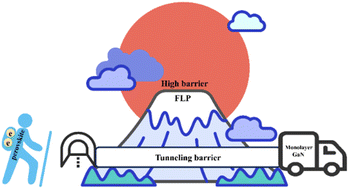
Selecting the appropriate electron transport layer and adjusting the interface performance are common strategies to enhance the charge transfer efficiency of perovskite solar cells. However, such interfaces often suffer from strong Fermi-level pinning (FLP) and high contact barriers, which severely limit device performance. Here, we report a solution through the design of a vdW dual-semiconductor heterojunction (DSH) composed of lead-free Cs3YSr3I12 perovskite and monolayer GaN. The Cs3YSr3I12/GaN structure largely removed interface gap states (IGSs) within the numerical resolution of our DFT calculations, leading to a zero contact barrier and the formation of quasi ohmic contacts. The FLP effect is weakened with a pinning factor of 0.74, approaching the ideal Schottky–Mott limit. The key innovation lies in utilizing the negative electron affinity (NEA) at the Y/GaN (0001) interface to lower the vacuum energy level below the conduction band minimum (CBM), which offsets the unfavorable interface dipole moment and forms a negative work function, thereby enabling spontaneous electron injection at the interface. Consequently, the heterojunction achieves an exceptional tunneling efficiency of 97.1% and a high conductivity of 7.97 × 10³ S cm−1. This work highlights the significant potential of GaN as an electron transport layer for lead-free perovskite applications in high-performance solar cells, photovoltaic devices, and photodetectors.
 Please wait while we load your content...


