


 PLATFORM UPDATE:


Cascade transformed MOF-derived CoFeS@NiV-LDH flower-on-leaf heterostructures for binder-free hybrid supercapacitors

Abstract
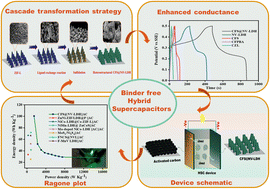
Metal–organic frameworks (MOFs) are compelling candidates for electrochemical energy storage owing to their high specific surface areas and tunable porosities; however, their limited intrinsic conductivity and the presence of intricate, inaccessible pores often hinder overall electrochemical performance. Herein, a cascade transformation strategy is reported to engineer a unique “flower-on-leaf” hierarchical heterostructure. In this architecture, ZIF-L-derived CoFe-sulfide (CFS) “nanoleaves” grown on Ni foam serve as a conductive backbone for the in situ assembly of NiV-layered double hydroxides (NV-LDH) “nanoflowers.” This integrated sulfide-LDH heterointerface is expected to generate interfacial charge redistribution and thereby create a built-in electric field, promoting ion/electron migration and facilitating multimetal faradaic redox reactions. Consequently, the binder-free, self-supported CFS@NV-LDH electrode delivers a high specific capacitance of 1532.80 F g−1 with 90.47% retention after 10 000 cycles. Furthermore, an asymmetric hybrid supercapacitor assembled with this cathode achieves a maximum energy density of 100.66 Wh kg−1 at a power density of 1500 W kg−1, along with excellent long-term cycling stability (90.56% retention over 10 000 cycles). This work presents a versatile methodology for fabricating MOF-based hierarchical heterostructures with optimized interfacial properties for high-performance next-generation energy storage devices.
 Please wait while we load your content...


