


 PLATFORM UPDATE:


High capacity metal-rich copper sulfide as an intercalation-type cathode material for all solid-state batteries
 *a
and
Taeseup
Song
*ac
*a
and
Taeseup
Song
*ac
Abstract
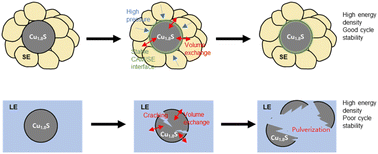
All solid-state batteries (ASSBs) employing sulfide-based electrolytes have attracted great attention as emerging energy storage systems due to high safety, high energy density, broad operating temperatures, etc. However, the introduction of sulfide-based solid electrolytes causes interfacial side-reactions with cathode/anode materials, resulting in electrochemical degradation. Here, we report a new intercalation-type Cu1.8S cathode material with a high capacity and interfacial compatibility for ASSBs. Compared to metal sulfides (MxS), copper sulfides only have metal-rich phases (x ≥ 1.6) due to the unique oxidation state of +1, enabling no weak S–S bonds, all strong Cu–S bonds, and a structural rigidness upon intercalation of foreign atoms. As a starting material, spherical microparticles assembled from CuS nanocrystals are prepared by a solvothermal method. After calcination at 300 °C, the CuS granules are transformed to porous Cu1.8S microspheres with a particle size of 1–3 µm and a surface area of 1.4 m2 g−1. A Cu1.8S-based cathode shows a charge/discharge capacity of 274 mAh g−1, a capacity retention of 80% over 100 cycles, and a high-rate capability of ∼190 mAh g−1 at 1C-rate in a potential window of 0.5–2.5 V vs. Li/Li+, leading to 1.5 times higher energy density than that of the conventional LiCoO2 cathode. In addition, it shows a suppressed side reaction and electrochemical compatibility with the sulfide-based electrolyte. The achievements open a new avenue for the potential use of copper sulfides as cathode materials for ASSBs.
 Please wait while we load your content...


