


 PLATFORM UPDATE:


Broadening the horizons of Fe-metal in static batteries with anion exchange membranes

Abstract
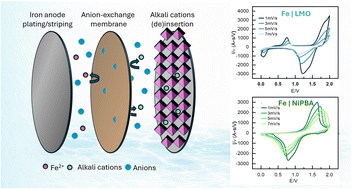
Iron-based batteries are attracting growing attention as sustainable and cost-effective systems for large-scale energy storage. Iron offers key advantages in aqueous environments, including natural abundance, high theoretical capacity, and environmental safety. However, the practical deployment of Fe-based batteries is hindered by parasitic hydrogen evolution, dendritic Fe deposition, and the narrow electrochemical window governed by the Fe2+/Fe3+ redox couple. To address these intrinsic challenges, we introduce a new cell design that employs an anion-exchange membrane (AEM) to separate the Fe anode from the catholyte. The AEM selectively conducts anions while blocking Fe2+ migration toward the cathode compartment, effectively preventing cross-contamination. This configuration enables the Fe anode to be coupled with a wide range of aqueous cathodes without mutual interference, thereby broadening the design flexibility of iron-based systems. Using concentrated LiCl or NaCl electrolytes as the catholyte and mixed FeCl2–LiCl/NaCl solutions as the anolyte, we demonstrate stable operation of electrochemical cells composed of Fe anodes and LiMn2O4 or NiFe(CN)6 cathodes. These systems deliver a capacity of 120 and 60 mAh g−1, respectively, based on the cathode mass. We believe that this newly developed concept provides a practical route to stabilize iron electrochemistry in aqueous media, offering a platform for the design of scalable, low-cost, and environmentally benign energy storage technologies suitable for grid applications.
- This article is part of the themed collection: Advanced aqueous batteries
 Please wait while we load your content...


