


 PLATFORM UPDATE:


Flexible and lightweight PVDF–CsPbBr2I piezoelectric nanogenerator with enhanced interfacial coupling for versatile high-output sensing applications
 b
Asim
Roy
*a
b
Asim
Roy
*a
Abstract
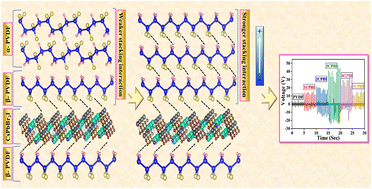
PVDF-metal halide perovskite nanocomposites have recently emerged as compelling candidates for high performance piezoelectric nanogenerators. Although substitutional engineering has unlocked remarkable functional enhancements in halide perovskites across a spectrum of applications, the potential of doping strategies to tailor their role within PVDF based nanogenerators remains a critical avenue for future exploration. In this study, highly efficient PVDF–CsPbBr2I nanocomposites are fabricated, with their performance optimized by tailoring the perovskite loading (1–5 wt%). Systematic optimization reveals that the composite with 3 wt% loading (3CPBI) exhibits markedly enhanced crystallinity and achieves a maximum β-phase fraction of 90.3%. This optimized structure yields significant improvements in the dielectric constant (56) and piezoelectric coefficient (33.3 pm V−1), corresponding to ∼4-fold and 2.5-fold enhancements over pristine PVDF, respectively. First principles calculations attribute these improvements to the interfacial charge transfer, which stabilizes the all trans PVDF conformation and enhances the overall polarization. PENG fabricated using the 3CPBI film produces an impressive output voltage of 47.8 V and a current of 9.28 µA under a mechanical pressure of 22 kPa. A maximum power output of 120.9 µW is achieved at a matched load of 6 MΩ. Furthermore, the device effectively powers electronic components such as LEDs and capacitors, and demonstrates sensitive voltage responses under light-weight object impacts and biomechanical stimuli, indicating its potential for multifunctional sensing and wearable energy harvesting applications.
 Please wait while we load your content...


