


 PLATFORM UPDATE:


Quaternary morpholinium-mediated defect control in high-performance perovskite solar cells
 *a
*a
Abstract
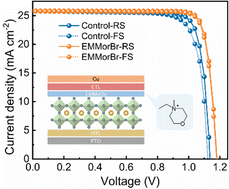
Although perovskite solar cells (PSCs) have achieved impressive efficiency advancements, their surface-dominated defects and poor environmental robustness still restrict device performance and durability. Here, we develop a multifunctional morpholinium-based quaternary ammonium salt, 4-ethyl-4-methylmorpholinium bromide (EMMorBr), as an efficient post-treatment molecule to modulate perovskite surface chemistry and interfacial energetics. Benefiting from its unique molecular configuration, EMMorBr enables dual-site defect passivation through the strong coordination between its electron-rich oxygen atom and under-coordinated Pb2+, as well as electrostatic interactions between quaternary ammonium cations and halide vacancies. Meanwhile, hydrogen bonding interactions restrain organic cation vacancy formation, leading to suppressed non-radiative recombination and improved interfacial charge extraction. The resulting films exhibit enhanced crystallinity, reduced trap density, and more favorable energy-level alignment. As a consequence, the EMMorBr-modified inverted PSCs achieve a champion power conversion efficiency of 26.14% with negligible hysteresis. Moreover, the devices display remarkable environmental durability. This work offers a rational molecular-engineering strategy toward high-efficiency and stable PSCs by leveraging quaternary onium salt chemistry.
 Please wait while we load your content...


