


 PLATFORM UPDATE:


Organic–inorganic interface engineering for integrated control of surface sites and hydrogen dynamics in chemoselective hydrogenation
 *ab
*ab
Abstract
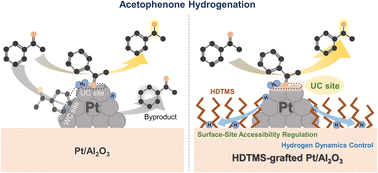
Achieving high chemoselectivity in structure-sensitive heterogeneous hydrogenation reactions remains challenging, as conventional catalysts typically face a trade-off between selectivity and activity owing to competing adsorption and reaction pathways on metal surfaces. To address this, we report an interfacial organic grafting strategy that simultaneously regulates surface-site accessibility and hydrogen dynamics in Pt catalysts supported on non-reducible γ-Al2O3. Hexadecyltrimethoxysilane (HDTMS) is grafted onto the support surface prior to Pt deposition, generating Pt–HDTMS(x) catalysts with a low Pt loading of 0.5 wt%. Although HDTMS grafting significantly reduces the number of accessible Pt sites, the modified catalysts exhibit enhanced chemoselectivity and activity in acetophenone hydrogenation. Complete conversion with high chemoselectivity toward 1-phenylethanol is achieved under mild hydrogenation conditions, while undesired aromatic ring hydrogenation and overhydrogenation are effectively suppressed. Spectroscopic analyses reveal that HDTMS grafting selectively passivates well-coordinated Pt terrace sites while preserving under-coordinated sites that favor C![[double bond, length as m-dash]](https://www.rsc.org/images/entities/char_e001.gif) O hydrogenation. In parallel, hydrogen activation and spillover are promoted, leading to substantially increased turnover frequencies. The catalysts also show excellent stability under a wide range of hydrogen pressures and repeated cycling. These results demonstrate that organic–inorganic interface engineering provides an effective means to simultaneously enhance chemoselectivity and activity, enabling the rational design of efficient hydrogenation catalysts with low metal loadings.
O hydrogenation. In parallel, hydrogen activation and spillover are promoted, leading to substantially increased turnover frequencies. The catalysts also show excellent stability under a wide range of hydrogen pressures and repeated cycling. These results demonstrate that organic–inorganic interface engineering provides an effective means to simultaneously enhance chemoselectivity and activity, enabling the rational design of efficient hydrogenation catalysts with low metal loadings.
 Please wait while we load your content...


