


 PLATFORM UPDATE:


Medium-entropy iron-series metal sulfide for energy-saving hydrogen production and highly-efficient direct hydrazine borane fuel cells
 *a
*a
Abstract
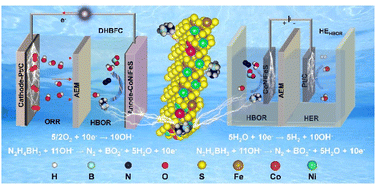
Hydrazine borane (HB) is a promising energy carrier for energy-saving electrolysis and direct liquid fuel cells. However, hydrazine borane oxidation reaction (HBOR) catalysts remain underexplored. The critical issue is the easy hydrolysis of HB in alkaline media, which significantly limits the electrochemical selectivity and energy efficiency. This work designs a medium-entropy metal sulfide (CoNiFeS) electrocatalyst with low-valent and electron-rich metal Co active sites to lower the HBOR energy barrier while suppressing HB hydrolysis. Electrochemical tests show that the medium-entropy CoNiFeS catalyst achieves 10 mA cm−2 at −0.133 V vs. RHE for the HBOR and operates stably for 206 h at 50 mA cm−2. The novel HBOR‖HER electrolyzer driven by the CoNiFeS catalyst reduces electricity consumption by 85.5% at 20 mA cm−2 compared to the traditional OER‖HER electrolyzer. Additionally, the direct hydrazine borane fuel cell (DHBFC) driven by the CoNiFeS catalyst delivers a high peak power density of 156 mW cm−2, which enables a self-powered HBOR‖HER hydrogen production system to achieve a hydrogen production rate of 4.5 mol h−1 m−2 under ambient conditions. This medium-entropy metal sulfide catalyst with >99% HBOR selectivity is favorable for the practical applications of HB in energy-saving electrolyzers and direct liquid fuel cells.
- This article is part of the themed collection: Journal of Materials Chemistry A HOT Papers
 Please wait while we load your content...


