


 PLATFORM UPDATE:


From layer sliding to near-zero compressibility: novel high-pressure flexibility and CO2 site evolution in pre-ELM-11 and ELM-11
 *a
and
Yang
Song
*a
*a
and
Yang
Song
*a
Abstract
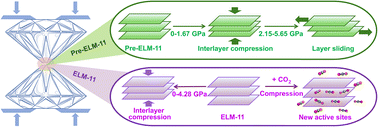
Understanding how mechanical stress reshapes flexible metal–organic frameworks (MOFs) is important for designing robust, stimuli-responsive CO2 sorbents. Here we compare the high-pressure flexibility of the elastic layered MOF ELM-11 and its hydrated precursor pre-ELM-11 using in situ synchrotron powder X-ray diffraction (PXRD) and Fourier-transform infrared (FTIR) spectroscopy. Pre-ELM-11 shows a pronounced change in anisotropic response at 2.15 GPa: compression along the c axis switches from positive linear compressibility (PLC) to negative linear compressibility (NLC), consistent with a transition from interlayer compression to pressure-driven layer sliding. In contrast, activated ELM-11 undergoes continuous anisotropic compression from 0.12 to 4.28 GPa dominated by interlayer contraction, and principal-axis analysis reveals near-zero linear compressibility (ZLC) along X3. To probe pressure-tuned host–guest interactions, we further monitor CO2-loaded ELM-11 by in situ FTIR. Deconvolution of the ν3 band of natural-abundance 13CO2 resolves an increase in distinct adsorption environments from two to three at 3.44 GPa, with additional sites appearing above 9.59 GPa. Together, these results map distinct pressure-activated deformation pathways in closely related layered frameworks and demonstrate that mechanical pressure can reveal and create new CO2 binding environments, informing the design of flexible 2D MOFs for pressure-responsive gas adsorption. More broadly, the comparative results identify interlayer hydrogen-bond pinning and initial interlayer spacing as key molecular levers that select pressure-activated deformation pathways and thereby tune pressure-dependent CO2 site heterogeneity in layered flexible MOFs.
 Please wait while we load your content...


