


 PLATFORM UPDATE:


Exploring confined media in hybrid mesoporous silicas via thermoporosimetry

Abstract
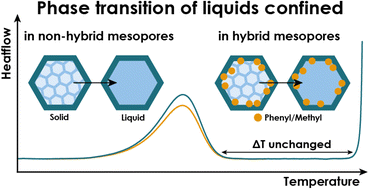
We revisit thermoporosimetry (TPM) as a probe of phase transitions in confined media and address an unresolved question: to what extent does pore surface chemistry influence melting point depression in nanoconfinement? Surface functionalization is generally expected to modify solid–liquid interfacial energies and thus perturb the Gibbs–Thomson relation underlying TPM analysis. Here, we test this assumption by establishing calibration curves between melting point depression ΔT and pore radius r using four probe solvents (water, decane, benzene, 1,2,4-trichlorobenzene) in well-defined non-hybrid mesoporous silica, and subsequently applying these calibrations to hybrid materials functionalized with phenyl and methyl groups. Despite substantial modification of pore wall chemistry, the melting–freezing transitions in hybrid materials follow the same ΔT – r relationships as their non-hybrid analogues. This invariance demonstrates an unexpectedly high transferability of the thermoposimetry across chemically distinct pore environments, significantly simplifying the characterization of functional mesoporous materials.
- This article is part of the themed collection: Celebrating the 80th birthday of Professor Dr Ulrich Schubert
 Please wait while we load your content...


