


 PLATFORM UPDATE:


Highly flexible, strong and dynamic recovery solid-solid phase change materials based on polythiourethane–polyurethane for thermal management

Abstract
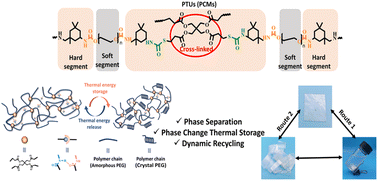
Addressing the critical challenges of leakage in physically encapsulated phase change materials (PCMs) and the non-recyclability of chemically crosslinked PCMs, this study introduces a sustainable PCM system based on dynamically reversible thiocarbamate bonds (TCBs). The TCB-crosslinked network enables exceptional shape stability (zero leakage observed) during phase transitions and endows the material with efficient recyclability. By modulating polyethylene glycol (PEG) weight content, the phase transition temperature is precisely tunable within a broad range (15.2–51.5 °C), ensuring adaptability to diverse thermal management scenarios. The material exhibits a high latent heat capacity of 77.0 J g−1, supported by a microphase-separated structure and multiple hydrogen-bonding networks that enhance thermal reliability. Remarkably, a synergistic balance between crosslinking density and dynamic bonds confers outstanding mechanical properties, achieving a tensile strength of 28.3 MPa and ductility of 976.0%, overcoming the brittleness typical of conventional PCMs. Leveraging the dynamic reversibility of TCBs, solvent-mediated decrosslinking and hot-press molding methods enable material recovery rates exceeding 90%, establishing a closed-loop lifecycle. This work provides a paradigm-shifting strategy for designing high-performance, recyclable PCMs that integrate robust thermal regulation, structural integrity, and environmental sustainability for advanced thermal energy storage applications.
 Please wait while we load your content...


