


 PLATFORM UPDATE:


Dopant-controlled transition-metal ordering in high-voltage spinel cathodes

Abstract
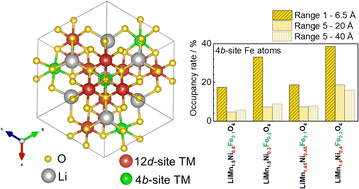
The ongoing advancement of rechargeable batteries has motivated extensive efforts to optimise cathode materials through targeted chemical doping to enhance electrochemical performance. Yet, the atomic-scale consequences of transition metal substitution, particularly its influence on atomic arrangement and/or cation ordering, remain insufficiently understood. A central challenge arises because transition metal dopants frequently occupy the same crystallographic site as the host transition metal species, complicating the analysis of the resulting cation distribution. Previous neutron pair distribution function (NPDF) investigations of the spinel cathode LiMn1.5Ni0.5O4 have shown that comparing local (short-range) and average (long-range) site occupancies of Mn and Ni can provide valuable insight into transition metal arrangements. Building upon this strategy, the present work employs NPDF to examine how Fe doping modifies lattice parameters and cation ordering within the spinel framework. Fe substitution is particularly attractive because it offers cost advantages and has been linked to improved electrochemical performance. This study identifies how Fe incorporation modifies the site occupancy of Mn and Ni, determines the preferential lattice sites adopted by Fe, and establishes an analytical framework for disentangling dopant-induced structural modifications in oxide cathodes.
- This article is part of the themed collection: Celebrating our 2026 Prizewinners
 Please wait while we load your content...


