


 PLATFORM UPDATE:


Ge-induced cation ordering for enhanced thermoelectric performance in AgSbTe2

Abstract
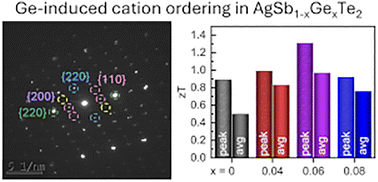
Waste heat recovery through thermoelectric conversion is a promising route toward sustainable energy utilization. AgSbTe2 is a notable mid-temperature thermoelectric material owing to its inherently low thermal conductivity. However, its performance is limited by Ag2Te precipitates and cation disorder. In this study, Ge doping is introduced as an effective approach to promote Ag/Sb cation ordering and suppress Ag2Te formation, as evidenced by synchrotron XRD, pair distribution function (PDF) refinements, and TEM/SAED analyses. The improved structural coherence mitigates grain-boundary scattering and optimizes carrier transport, leading to enhanced parameters such as weighted mobility (µW), quality factor (B), and electronic transport coefficient (σE0). Hall measurements confirm an increase in carrier concentration alongside an optimized effective mass, indicating partial decoupling of the Seebeck coefficient and electrical conductivity. The optimized composition achieves a nearly temperature-independent power factor of 1.15 mW m−1 K−2 between 300 and 675 K, with a peak zT of 1.31 at 673 K and an average zT of 0.97 across the same range. A single-leg device generates 25 mW output power (ΔT = 370 K), underscoring AgSb0.94Ge0.06Te2's promise for practical mid-temperature energy conversion. Single parabolic band (SPB) analysis suggests that further enhancement in zT is possible through tailored thermal conductivity reduction.
- This article is part of the themed collection: Thermoelectric energy conversion
 Please wait while we load your content...


