


Scavenger-free and high-efficiency photoreduction of concentrated Cr(vi) via MOF@COF heterojunctions: the role of interfacial charge transfer
 *a
Jianjun
Wang
*a
*a
Jianjun
Wang
*a
Abstract
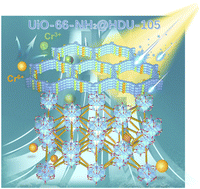
UiO-66 exhibits exceptional stability compared to other metal–organic frameworks (MOFs), while its amino-functionalization enhances photocatalytic performance. Similarly, covalent organic frameworks (COFs) like the cyano-containing HDU-105 serve as ideal photocatalytic platforms due to their optoelectronic properties and ability to improve charge separation. In this study, we designed a series of core–shell structured UiO-66-NH2@HDU-105 heterojunctions for the efficient photocatalytic reduction of hexavalent chromium (Cr(VI)). We systematically investigated the optimal combination ratio, finding that a MOF@COF mass ratio of 2 : 1 achieved a maximum reduction efficiency exceeding 99%, significantly outperforming individual UiO-66-NH2 (31%) and HDU-105 (36%). Mechanistic studies revealed that the composite operates via a Z-scheme charge transfer pathway; electrons transfer from the conduction band of UiO-66-NH2 to the valence band of HDU-105, while h+ accumulates in the UiO-66-NH2 region. Under acidic conditions, electrons attached to HDU-105 can directly reduce Cr(VI) to Cr(III). Furthermore, the UiO-66-NH2@HDU-105 composite demonstrated excellent selectivity and long-term stability in both laboratory settings and real water matrices (groundwater and surface water). Ultimately, this study presents a viable design strategy for developing efficient and robust photocatalysts for heavy metal remediation.
 Please wait while we load your content...


