


 PLATFORM UPDATE:


Digital and experimental design of CO2-responsive polymers based on acrylamide monomers for carbon capture
 a
and
Prokopios
Georgopanos
*a
a
and
Prokopios
Georgopanos
*a
Abstract
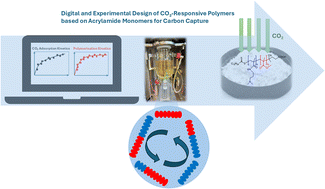
This study provides a comprehensive evaluation of the CO2 capture performance of the CO2-responsive homopolymer poly(N-[3-(dimethylamino)propyl]-acrylamide) (PDMAPAm) and its diblock copolymer poly(N-[3-(dimethylamino)propyl]-acrylamide)-b-poly(methyl methacrylate) (PDMAPAm-b-PMMA), with a particular emphasis on their integration into membrane adsorbers for direct air capture (DAC) applications. A central novelty of this work is the development of a pioneering unified kinetic model that, for the first time, couples polymerization reaction kinetics with CO2 adsorption kinetics. This model enables the digital predictive design of polymer materials whose CO2 uptake is expressed directly as a function of polymer properties. By systematically varying the molar mass of the amine-functional PDMAPAm block and the poly(methyl methacrylate) (PMMA) content, this study identifies the optimal polymer properties that balance high CO2 uptake with favorable processing characteristics. Adsorption experiments conducted under dry conditions revealed a physisorption-dominated mechanism, where CO2 primarily interacts with tertiary amine and carbonyl functional groups. Notably, the unified model predicted a target molar mass of 18.5 kDa for the homopolymer of PDMAPAm and identified the optimal synthesis ratio of RAFT : initiator : monomer. This model also accurately forecasts the CO2-uptake capacity of the PDMAPAm homopolymer to be 0.05 mmol g−1 and that of its corresponding diblock copolymer (PDMAPAm-b-PMMA) to be approximately 0.1 mmol g−1 under dry ambient conditions.
- This article is part of the themed collection: Journal of Materials Chemistry A HOT Papers
 Please wait while we load your content...


