


 PLATFORM UPDATE:


Toward unified interphase engineering: the solid-electrolyte interphase in batteries and supercapacitors
 *a
Khayrul
Islam
*c
and
*a
Khayrul
Islam
*c
and
Abstract
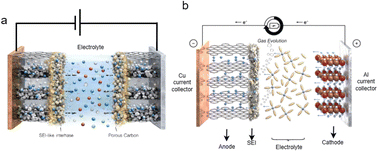
The development of next-generation electrochemical energy storage requires devices that synergistically combine the high energy density of batteries with the exceptional power capability and cycle life of supercapacitors, yet fundamental understanding of the interfacial phenomena governing performance across these platforms remains fragmented. While the solid-electrolyte interphase (SEI), a nanometer-scale passivation layer formed by electrolyte decomposition, has been extensively characterized in battery systems, analogous interfacial films in supercapacitors have received limited systematic investigation despite mounting experimental evidence for their existence and functional significance. This review advances the thesis that SEI formation constitutes a general electrochemical phenomenon arising whenever applied potentials drive electrode Fermi levels into electrolyte molecular orbitals beyond thermodynamic stability limits, independent of whether charge storage proceeds via faradaic redox or non-faradaic electrostatic mechanisms. Distinctions between battery SEIs (10–100 nm thickness, quasi-static evolution) and supercapacitor interphases (1–10 nm, dynamic reconstruction) reflect operational boundary conditions (potential range, cycling frequency, and ion flux) rather than fundamental mechanistic divergence. Quantitative analysis across reported studies indicates that interphase ionic resistivity (or fitted RSEI) generally increases as the interphase becomes more inorganic-rich (e.g., LiF/Li2CO3-dominated), although the reported ranges depend strongly on morphology/porosity, thickness, and the EIS fitting model and protocol Critically, rationally engineered interphases achieved through electrolyte additive optimization, atomic-layer-deposited protective coatings, or electrode surface functionalization substantially suppress parasitic leakage currents, maintain capacitance retention above 95% through tens of thousands of cycles, and enable stable operation exceeding 3.0 V in organic and ionic-liquid electrolytes. By establishing shared mechanistic principles and facilitating systematic knowledge transfer between battery and supercapacitor research communities, this unified framework enables predictive interphase engineering strategies that deliver battery-level energy density, capacitor-level power capability, and ultralong operational lifetimes for electrified transportation, renewable grid integration, and sustainable infrastructure.
- This article is part of the themed collection: Journal of Materials Chemistry A Recent Review Articles
 Please wait while we load your content...


