


 PLATFORM UPDATE:


Residual oxygen-driven p–n conversion and thermoelectric properties in CrN films

Abstract
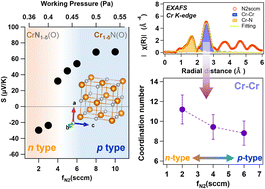
Transition metal nitrides such as CrN are promising for thermoelectric applications due to their high stability and tunable electronic properties, yet they have been largely limited to n-type conduction, restricting device design. Here, we report the successful synthesis of p-type CrN films via controlled residual oxygen incorporation during RF magnetron sputtering regulated through N2 gas flow adjustment, without introducing any additional oxygen source. A low N2 gas flow rate (fN2) produces N-deficient CrN1−δ(O) films with n-type conduction dominated by nitrogen vacancies, while higher fN2 (≥4 sccm) stabilizes Cr vacancies in over-stoichiometric Cr1−δN(O) films, resulting in p-type hole conduction. Cr K-edge X-ray absorption fine structure (XAFS) reveals Cr–Cr bond elongation, reduced coordination, and enhanced Cr3d–O/N2p hybridization, indicative of localized hole states. Temperature-dependent transport measurements confirm the mechanisms, leading to a room-temperature power factor (PF) up to 0.105 mW m−1 K−2 (n-type) and 0.053 mW m−1 K−2 (p-type). The structural similarity between the n- and p-type films enables the creation of p–n homojunctions, highlighting a straightforward route for CrN-based thermoelectric devices.
- This article is part of the themed collection: Thermoelectric energy conversion
 Please wait while we load your content...


