


 PLATFORM UPDATE:


MXenes as multifunctional mediators in lithium–sulfur batteries: a data-driven review

Abstract
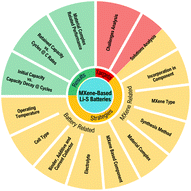
Lithium–sulfur (Li–S) batteries offer a compelling pathway toward high energy density. However, they face persistent challenges, including the polysulfide shuttle effect, slow redox kinetics, and the low electrical conductivity of sulfur species. MXenes provide a versatile platform to mitigate these limitations. This data-driven survey of more than 200 studies maps the development of MXene-enabled strategies for Li–S batteries. Ti-based MXenes, particularly Ti3C2Tx, dominate current research (89.6% of studies), yet emerging trends emphasize complex heterostructures. These systems are primarily implemented as cathode hosts (57.4%) or as functional separator coatings and interlayers (40.1%). Leading approaches shift from passive polysulfide adsorption to active catalytic conversion, frequently enabled by synergistic multi-component architectures (30.1%). Benchmarking of reported electrochemical data indicates that high performance arises from materials integrating strong conductivity, hierarchical porosity, chemisorption capability, and catalytic activity. State-of-the-art configurations, often incorporating MXene-based interlayers, demonstrate capacity decay rates below 0.02% per cycle over more than 1000 cycles at rates above 1C. Despite substantial progress, a pronounced gap persists between laboratory testing and the requirements for commercial implementation. Most studies employ high electrolyte-to-sulfur (E/S) ratios and room-temperature coin cells, conditions far from practical deployment. Future advancement depends on broadening MXene compositions, adopting scalable and environmentally benign synthesis routes, and validating performance under practical operating conditions.
- This article is part of the themed collection: Journal of Materials Chemistry A Recent Review Articles
 Please wait while we load your content...


