


 PLATFORM UPDATE:


Selection of a single atom for surface charge modulation to promote CO2 activation and stabilize the *COOH intermediate for solar fuels
 cfghi
Heng-Liang
Wu,
cdj
Michitoshi
Hayashi,
*cd
Kuei-Hsien
Chen
*ci
and
Li-Chyong
Chen
*cdm
cfghi
Heng-Liang
Wu,
cdj
Michitoshi
Hayashi,
*cd
Kuei-Hsien
Chen
*ci
and
Li-Chyong
Chen
*cdm
Abstract
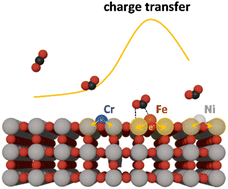
Modulating the surface charge distribution is a key strategy for enhancing photocatalytic CO2 reduction as it effectively activates the inert CO2 molecule into a reactive, bent configuration. However, the rational design of such catalysts is fundamentally challenged by the lack of a systematic, predictive guideline for selecting optimally anchored single-metal atoms. We address this critical gap by establishing a novel predictive metal selection principle based on the synergistic effect of the valence electron count and electronegativity of a single atom. This principle successfully guided the selection of transition metals (Cr, Fe, and Ni) anchored onto WO3 nanoplates via wet impregnation, ensuring selective surface modification while preserving the bulk properties. The Fe-anchored WO3 catalyst, identified by our principle, demonstrated the most substantial surface electron density localization. This rational optimization led to a remarkable three-fold enhancement in the PC-CO2RR efficiency, selectively yielding CO as the primary product. Comprehensive experimental and theoretical analyses confirmed that this localized charge accumulation promotes significantly stronger CO2 chemisorption and critically stabilizes the key intermediate, *COOH. Specifically, the reaction became thermodynamically spontaneous with ΔG(*COOH) = −1.73 eV. Our findings establish a strong correlation between the localized surface charge density and CO2 activation, providing a fundamental and generalizable guideline for the rational design of high-performance catalytic materials for energy and sustainability applications.
 Please wait while we load your content...


