


 PLATFORM UPDATE:


Tantalum oxynitride (TaON): synthesis routes, structural diversity, and solar water splitting activity

Abstract
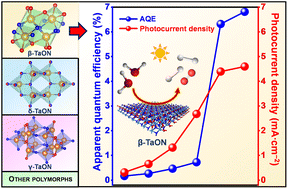
Tantalum oxynitride (TaON) is a promising mixed-anion semiconductor for visible-light-driven photocatalytic (PC) and photoelectrochemical (PEC) water splitting. By linking the properties of tantalum oxide and nitride, TaON exhibits a balanced bandgap (2.4–2.8 eV), suitable band-edge positions for water redox reactions, and tunable synthesis routes, which make it highly attractive in sustainable hydrogen production. Since its discovery as an intermediate between Ta2O5 and Ta3N5, TaON has been extensively studied to correlate synthesis conditions, crystal structure, and defect chemistry with its solar water splitting activity. This review summarizes key advances, including experimentally confirmed polymorphs (baddeleyite-, VO2(B)-, anatase-, rutile, cotunnite-, bixbyite-, anosovite-, etc.) and theoretically predicted structures, emphasizing how processing routes from conventional ammonolysis to thin-film deposition govern phase selectivity, defect density, and optoelectronic properties. Theoretical and experimental studies converge on the stability of stoichiometric versus non-stoichiometric compositions and the intrinsic n-type conductivity of TaON. Strategies, such as cation doping, solid-solution formation, particle size control, and morphology optimization, which enhance visible-light absorption, charge separation, and reaction kinetics, are discussed. Post-synthetic modifications, including cocatalyst loading and heterostructure formation (Z-scheme, S-scheme, and multijunction systems), have further improved efficiency and stability. Incorporation of IrO2, CoOx, or NiOx cocatalysts has increased PEC photocurrent densities up to 4.6 mA cm−2 and apparent quantum efficiencies to 25.5% at 420 nm, while Z-scheme systems, such as Pt/ZrO2-TaON + Pt/WO3, achieved overall water splitting with apparent quantum efficiency (AQE) values up to 6.3%. Despite challenges from anion disorder, chemical instability, and limited visible-light absorption, TaON remains an important photocatalyst for defect, doping, and interface engineering in oxynitride compounds, guiding the rational design of next-generation photocatalysts for solar-to-hydrogen conversion and other solar-driven redox reactions.
- This article is part of the themed collection: Journal of Materials Chemistry A Recent Review Articles
 Please wait while we load your content...


