


 PLATFORM UPDATE:


Size-dependent amorphous–crystalline phase transitions in ultra-small gold colloids
 ad
and
Damien
Alloyeau
*a
ad
and
Damien
Alloyeau
*a
Abstract
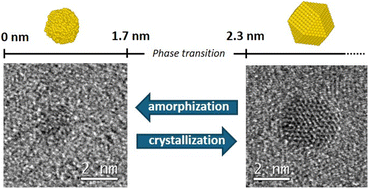
Understanding the atomic-scale mechanisms governing the structural evolution of ultra-small metal nanoparticles (NPs) is critical for controlling their synthesis and properties in catalysis and nanomedicine. Using aberration-corrected high-resolution transmission electron microscopy in graphene liquid cells, we investigated the dynamics of ultra-small gold colloids at the atomic scale during their growth by Ostwald ripening. This slow coarsening process in which atoms flux between NPs can make them grow or shrink allows us to shed new light on the size-dependent amorphous–crystalline phase transition in gold colloids. Indeed, NPs larger than 2.3 nm are crystalline, while NPs smaller than 1.7 nm are always amorphous. Interestingly, the phase transition between these two phases is systematically observed between 1.7 and 2.3 nm, both during the growth and the dissolution of NPs. The reversibility of this transition suggests a size-dependent equilibrium between amorphous and crystalline phases that is confirmed by Monte Carlo simulations performed within a tight-binding framework. Beyond offering quantitative insights into the phase diagrams of ligand-free gold colloids, these in situ observations provide mechanistic insights into the formation of monocrystalline nanostructures that could help rationalize the growth control of metal NPs.
 Please wait while we load your content...


