


 PLATFORM UPDATE:


Integrated overview of solvents and materials for reactive carbon capture and utilization
 *cd
and
Hankwon
Lim
*abe
*cd
and
Hankwon
Lim
*abe
Abstract
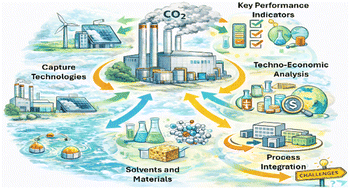
Carbon dioxide (CO2) capture remains a critical strategy for environmental decarbonization and achieving net-zero emissions in power generation and industrial sectors. Over the last two decades, diverse solvent-based strategies have emerged, involving absorbents such as aqueous amines, deep eutectic solvents (DESs), enzymes, ionic liquids (ILs), porous materials, and electrochemically regenerable solutions. While each class offers distinct advantages in reactivity, stability, and regeneration energy, direct comparisons across solvent types remain limited, hindering rational material selection for specific capture scenarios. Furthermore, emerging applications such as direct air and ocean capture, integrated capture and utilization (ICCU), as well as techno-economic analysis (TEA), introduce new challenges for solvent performance, compatibility, and process integration. This review provides a comprehensive assessment of solvent-based CO2 capture technologies, with an emphasis on performance metrics such as absorption capacity, regeneration energy, cycling efficiency, and economic viability. By integrating insights from molecular design, process engineering, and TEA, this review aims to provide a practical guide for the development and deployment of next-generation CO2 capture sorbents.
- This article is part of the themed collection: Journal of Materials Chemistry A Recent Review Articles
 Please wait while we load your content...


