


Stabilization of planar heterojunction solar cells using a dimethyl sulfoxide treated hole transport layer

Abstract
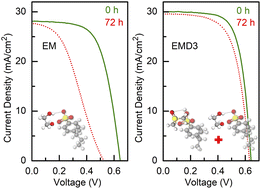
Heterojunction solar cells (HSCs) have gained attention in the field of renewable energy for their potential to combine the benefits of both crystalline silicon and thin-film technologies, thus offering high efficiency and relatively low manufacturing cost. However, several challenges, particularly those related to long-term stability and performance degradation, need to be addressed for commercial scalability. Resolving the durability issue requires innovative strategies through modification of key components such as the hole transport layer (HTL). This study investigates the stabilization of HSCs by addition of dimethyl sulfoxide (DMSO) to poly(3,4ethylenedioxythiophene)-poly(styrenesulfonate) (PEDOT:PSS) solutions modified with and without other cosolvents. Known for their cost-effectiveness and high efficiency, HSCs have been found to benefit significantly from the addition of DMSO to PEDOT:PSS. Our results show that the addition of DMSO to ethylene glycol and methanol (EM) modified PEDOT:PSS solution increases the electrical conductivity and greatly improves the stability of the fabricated solar cells by enhancing phase separation and reducing charge recombination. The sample prepared with a 3 wt% DMSO concentration in EM is found to exhibit the best performance in stability, retaining 89.4% of its initial efficiency after 72 h of ambient storage upon fabrication, in contrast to the control sample that loses half of its efficiency in the same duration, all without the use of any protective encapsulation. This work highlights the potential of DMSO in enhancing the durability and effectiveness of EM modified PEDOT:PSS-based solar cells, making DMSO-EM a promising cosolvent mixture for fabricating high-efficiency and intrinsically stable HSCs in the green energy evolution.
 Please wait while we load your content...


