


 PLATFORM UPDATE:


Pressure driven interplay of Rashba, Rashba–Dresselhaus and persistent spin texture in lead-free quasi-2D hybrid perovskites

Abstract
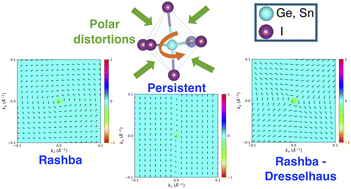
Quasi-2D hybrid halide perovskites have emerged as promising materials in the field of optoelectronics. However, the toxicity related to the presence of lead (Pb) in such lower dimensional systems remains a challenge, and has led to the discovery of lead-free analogues. In this work, we have envisaged two such quasi-2D hybrid halide perovskites with orthorhombic crystal structure (space group Pca21), based on germanium (Ge) and tin (Sn) in the form of (A-Pyr)2GeI4 and (A-Pyr)2SnI4, where A-Pyr is the pyridinium-based organic spacer C6H10N2. Based on the systematic electronic structure calculations and spin texture analysis, we have witnessed structural, electronic, optical and most interestingly spin texture evolution in both the perovskites under pressure. We have considered the pressure limits of 10.4 and 7.5 GPa, respectively, for Ge and Sn based systems, till the thermodynamic stability prevails with negative formation energy. The unique transition between Rashba (R), Rashba–Dresselhaus (RD) and persistent spin texture (PST) has been observed through the tuning of pressure on the systems. For (A-Pyr)2GeI4, PST emerges above 4.3 GPa in the valence band and at all the pressure point in the conduction band, with Rashba splitting strength (αR) reaching 0.73 eV Å. Interestingly, (A-Pyr)2SnI4 exhibits dynamic transitions between Rashba, Rashba–Dresselhaus splitting and PST, influenced by Sn 5p orbital contributions. A linear reduction of the bandgap has been observed in (A-Pyr)2GeI4, while in case of (A-Pyr)2SnI4, bandgap bowing has been observed under the influence of pressure, which has been correlated with bond-angle variance (σ2) trends in [GeI6]4− and [SnI6]4− octahedra. The red-shift in the optical absorption spectra governed by the external pressure is consistent with the electronic and spin-texture evolution. Our theoretical findings of this unique interplay between structural distortion, orbital hybridization, spin texture and corresponding optical transitions open up a new direction for exploring materials for optoelectronics and spin–orbitronic devices. This purely theoretical study highlights the potential of these materials for optoelectronic and spin–orbitronic applications, providing predictive insights that may guide future experimental investigations.
 Please wait while we load your content...


