


 PLATFORM UPDATE:


Dual-carbon batteries using fluorination and defluorination reactions

Abstract
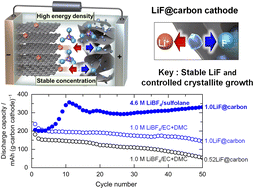
Dual-carbon batteries (DCBs) employing carbon-based electrodes are promising next-generation systems but suffer from limited capacity due to bulky anions and electrolyte instability during simultaneous (de)intercalation. Here, we demonstrate a new class of fluorination-based DCBs utilizing LiF as an F− source, paired with graphite anodes and Li-based concentrated sulfolane electrolytes for high-voltage operation. The system delivers a large initial reversible capacity of 356 mAh g−1 (per cathode carbon) and exhibits notable capacity retention, outperforming conventional DCB systems. Air-free X-ray diffraction analyses reveal that reversible electrochemical utilization of LiF, suppression of LiF crystallite growth, optimized carbon crystallite size, LiF retention on carbon cathodes, and restrained electrolyte decomposition collectively enable large capacity and stable cycling. These findings establish the first fluorination/defluorination-based DCBs as a feasible next-generation battery technology using the smallest ions (Li+ and F−) to achieve high energy density and cycling durability.
 Please wait while we load your content...


