


 PLATFORM UPDATE:


Uncertainty-aware dimensionality prediction of low-dimensional hybrid metal halides by integrating Bayesian modeling and experiments

Abstract
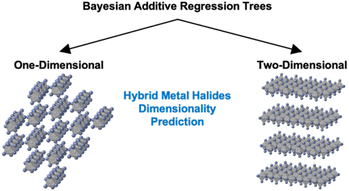
Data-driven materials informatics is revolutionizing materials design by uncovering complex structure–property relationships beyond traditional trial-and-error methods. In perovskites and more generally hybrid metal halides (HMHs), comprising metal halide anions and organic spacer cations, variations in the spacer cations can alter the inorganic framework dimensionality, which has direct consequences for optical and electronic properties. In this paper, we explore the factors impacting HMH dimensionality, with a focused experimental study and a broad materials informatics approach. Experimentally, we employed three structurally similar branched alkyl cations. Despite their close similarity, they produced distinct lead iodide hybrid frameworks: one forming a 2D layered structure and two forming 1D chain phases. These results confirm that molecular differences can dictate dimensionality. Expanding from these observations, we curated a dataset of 113 HMHs and applied Bayesian additive regression trees to predict dimensionality from molecular descriptors. Here, we show that Bayesian additive regression trees achieved a strong predictive power (posterior mean area under the curve of around 0.8) while quantifying uncertainty. The results highlight organic cation aspect ratio, polar surface area, and the number of branched points as dominant features for dimensionality prediction. An active learning strategy further enhanced model net improvement by ∼20%, increasing the efficiency of identifying promising candidates compared to random sampling. Together, this study provides both experimental evidence and machine learning rules that clarify how spacer cation structure governs HMH dimensionality, offering a data-driven path to rational design of low-dimensional hybrid semiconductors. By integrating experimental observations with data-driven modeling, this study highlights the potential of materials informatics to guide predictive design across structurally diverse material systems and motivates broader curation of well annotated materials datasets.
 Please wait while we load your content...


