


 PLATFORM UPDATE:


Introducing functionalities into directly synthesised amorphous UiO-66-based metal–organic frameworks

Abstract
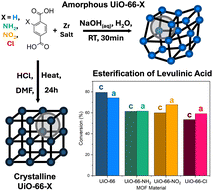
We report a scalable, water-based methodology for the direct room-temperature synthesis of porous amorphous UiO-66-type metal–organic frameworks (aMOFs), enabling the incorporation of a range of functionalised terepthalate linkers without organic solvents during framework formation. Powder X-ray diffraction and scanning electron diffraction confirm the formation of truly topologically amorphous UiO-66 derivatives, while pair distribution function (PDF) analysis shows that the amorphous frameworks retain the local structural motifs of their crystalline analogues despite the loss of long-range order. Relative to crystalline UiO-66, the directly synthesised amorphous UiO-66 exhibits a reduced but permanent porosity (BET surface area 286 vs. 997 m2 g−1 CO2-accessible pore volume 0.196 vs. 0.519 cm3 g−1), together with a high concentration of defects, consistent with a cluster : linker ratio of 1 : 5.3 compared with 1 : 6 for the ideal crystalline framework. In the esterification of levulinic acid, amorphous UiO-66 reaches 87.7% conversion to methyl levulinate after 3 h, compared with 75.5% for crystalline UiO-66, and retains 95% of its initial activity after five catalytic cycles (vs. 86% for the crystalline analogue). These results demonstrate that direct, water-based synthesis provides access to functional, porous, and highly defective amorphous UiO-66 materials with catalytic performance comparable to or exceeding that of their crystalline counterparts under the conditions studied.
 Please wait while we load your content...


