Development of high-performance deicing coatings through engineered weak interfacial domains

Abstract

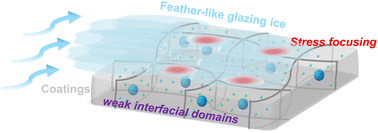
The development of effective anti-/de-icing coatings remains challenging for aviation applications where complex environmental factors and dynamic icing conditions demand robust material solutions. However, current strategies capable of achieving an optimal balance between deicing efficiency and mechanical durability have remained limited in scope and lack universal design principles. In this work, we engineer endogenous weak interfacial domains within polymer coatings that function as stress concentrators, triggering early crack nucleation and interfacial embrittlement. This approach reduces interfacial toughness (Г ice ) by 96% and ice adhesion strength (τ ice ) by 90% while maintaining sufficient stiffness (E = 1.11 MPa) through a low-cost fabrication method ($3/m²). The coating enables effective multi-scale ice removal, as demonstrated by low-rotational-speed ice shedding from UAV propellers under simulated flight conditions (supercooled droplets, d ≈ 0.02 mm, -6 °C). A coupled phase-field and cohesive zone model confirms the stress-focusing mechanism, establishing a universal framework for designing next-generation icephobic materials that optimize performance, durability, and cost.

Supplementary files

Transparent peer review

To support increased transparency, we offer authors the option to publish the peer review history alongside their article.

View this article’s peer review history

Article information

Article type
Paper
Submitted
05 Dec 2025
Accepted
02 Apr 2026
First published
02 Apr 2026

J. Mater. Chem. A, 2026, Accepted Manuscript

Development of high-performance deicing coatings through engineered weak interfacial domains

Z. Han, X. Tian, Y. Peng, L. Tian, J. Tu, J. Liu, W. Sun, Z. Xu, D. Wang and Z. Ma, J. Mater. Chem. A, 2026, Accepted Manuscript , DOI: 10.1039/D5TA09967F

To request permission to reproduce material from this article, please go to the Copyright Clearance Center request page.

If you are an author contributing to an RSC publication, you do not need to request permission provided correct acknowledgement is given.

If you are the author of this article, you do not need to request permission to reproduce figures and diagrams provided correct acknowledgement is given. If you want to reproduce the whole article in a third-party publication (excluding your thesis/dissertation for which permission is not required) please go to the Copyright Clearance Center request page.

Read more about how to correctly acknowledge RSC content.

Social activity

Spotlight

Advertisements