


 PLATFORM UPDATE:


Anion-engineered chalcogenide perovskites Ba2HfCh4: from light emitters to photovoltaics

Abstract
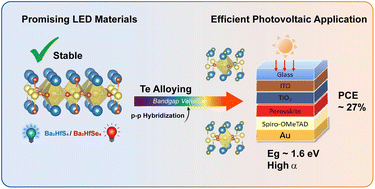
We present a systematic first-principles study of Ruddlesden–Popper chalcogenide perovskites Ba2HfS4 and Ba2HfSe4 and their Te-alloyed derivatives. Stability analysis confirms that only the barium-based parent compounds are dynamically and thermally stable. These parent phases possess direct bandgaps (3.57 eV and 2.54 eV), large exciton binding energies (0.79 eV and 0.67 eV), and strong optical absorption (105 cm−1), making them promising candidates for solid-state lighting. Controlled Te substitution enables continuous bandgap tuning from the UV to the visible range. An anomalous bandgap reversal at intermediate doping levels (Ba2HfS2Te2 and Ba2HfSe2Te2) is explained by a p–p hybridization mechanism that modulates the valence band maximum. Notably, the high-Te-content compounds Ba2HfSTe3 and Ba2HfSeTe3 exhibit ideal photovoltaic bandgaps (1.6–1.7 eV), high absorption coefficients (105 cm−1), and balanced carrier transport, yielding predicted power conversion efficiencies of ∼24% and ∼27%. This work primarily establishes these Te-rich compounds as high-performance photovoltaic absorbers, while also revealing the parent compounds as promising light-emitting candidates, demonstrating anion alloying as an effective strategy for multi-functional design in layered chalcogenides.
 Please wait while we load your content...


