


 PLATFORM UPDATE:


Static promise versus dynamic reality in a Z-scheme photocatalyst: nonadiabatic dynamics reveal a charge-separation bottleneck in MoSi2P4/WTe2

Abstract
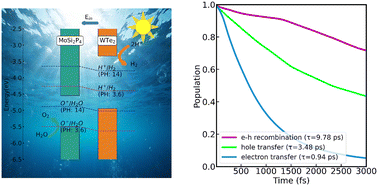
The practical efficiency of Z-scheme photocatalytic heterostructures is often limited by poorly understood interfacial carrier dynamics. While first-principles calculations predict promising static properties for many systems, the critical role of non-adiabatic dynamics remains largely unexplored. Here, we combine non-adiabatic molecular dynamics (NAMD) with first-principles calculations to reveal the ultrafast carrier dynamics in a MoSi2P4/WTe2 heterostructure. Static calculations confirm its direct Z-scheme band alignment and a high strain-tunable corrected solar-to-hydrogen efficiency up to 17.69%, positioning it as a competitive candidate among existing MoSi2P4-based heterostructures. However, NAMD simulations reveal a potential bottleneck for the ideal Z-scheme pathway: the interlayer electron–hole recombination (9.78 ps) is slower than both electron transfer (0.94 ps) and hole transfer (3.48 ps). We demonstrate that these processes are governed by nonadiabatic coupling induced by specific atomic vibrations, rather than static electronic coupling. This mechanistic insight highlights that robust static properties alone are insufficient to guarantee high photocatalytic performance, and that the often-overlooked carrier dynamics can be a decisive factor. This work provides a critical assessment of the MoSi2P4/WTe2 system and underscores the necessity of integrating time-domain investigations for a holistic understanding of photocatalytic heterostructures.
- This article is part of the themed collection: Journal of Materials Chemistry A HOT Papers
 Please wait while we load your content...


